
Slipware and Vernacular Glazes Across Five Centuries at Ehlers Samlingen
Clay and Domestic Life Across Five Centuries
In Haderslev, a 1577 half-timbered merchant house gives domestic pottery an unusually vivid setting. The building at Slotsgade 20 houses Ehlers Samlingen, described as Northern Europe”s largest pottery collection, with objects spanning approximately five centuries. Its wooden beams, Renaissance panel paintings, and painted ceilings create a compelling contrast with the vessels on display. Earthenware that once stood beside a hearth, pantry shelf, or kitchen table can be viewed here as both historical evidence and carefully made design.
The collection invites a change in scale. A storage jar may appear modest, yet its rounded body, irregular glaze, and hand-drawn ornament record choices about materials, labor, taste, and use. Across Scandinavia, humble red earthenware transformed functional necessity into visual expression. Pots held food, carried liquids, marked celebrations, and supported communal rituals, while their surfaces gave makers room for rhythm, humor, color, and gesture. At Ehlers Samlingen, the lineage leads from utilitarian household vessels toward the freer, more expressive language of early modernism.
The Chemistry of Regional Lead Glazes and Slip Trailing
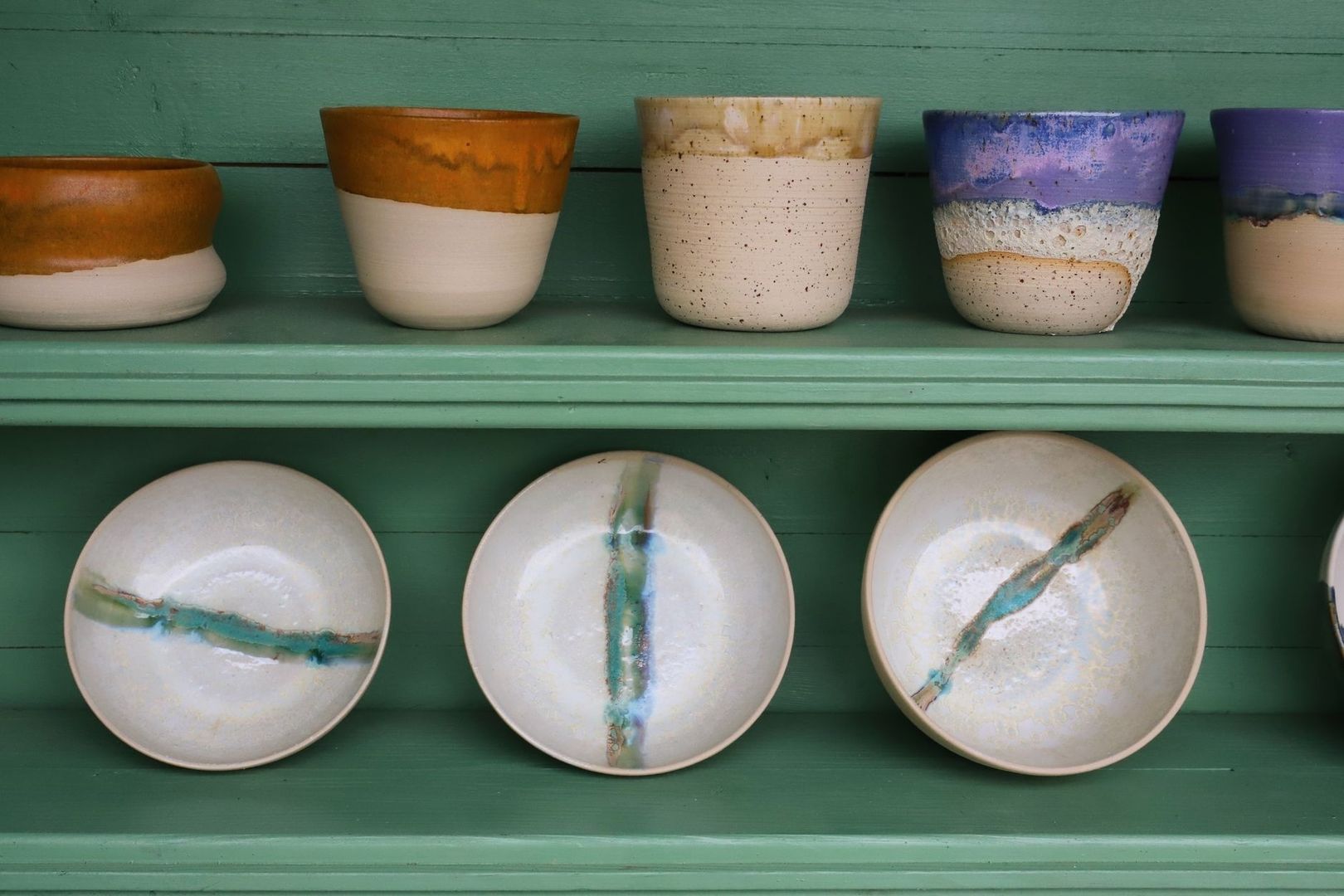
Look closely at Scandinavian red earthenware and the surface often seems to hold its own light. That effect came from a combination of porous, iron-rich clay and a low-fired lead glaze. The body could burn to shades of red, orange, or warm brown, while the glaze softened the surface into transparent amber, yellow, green, or brown. Because lead compounds melt at relatively low temperatures, they were practical for traditional earthenware kilns. They also produced a glossy coating that made vessels easier to clean and gave decoration a striking visual depth.
Traditional glaze recipes were not standardized industrial formulas. They depended on local clay, available minerals, ash, sand, and the experience of individual workshops. A potter adjusted the mixture according to the character of the clay body, the thickness of application, and the heat of the firing. Small changes could produce dramatic results: a thin coating might reveal the color and texture beneath, while a heavier application could pool in incised lines and recesses. The chemistry therefore became visible as atmosphere, variation, and surface tension.
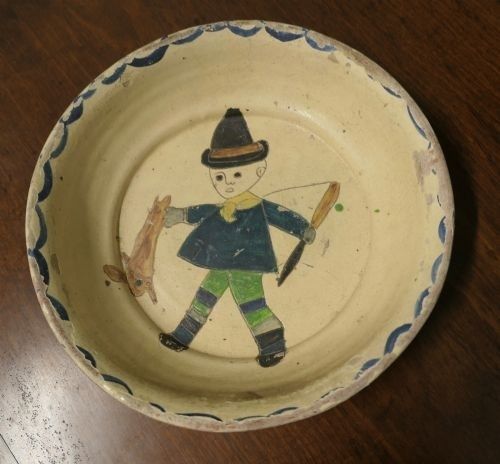
One of the most distinctive decorative processes was slip trailing, known in Danish as hornglasering. A liquid mixture of finely prepared clay, or slip, was placed in an animal horn fitted with a narrow opening. The potter squeezed and guided the horn across the damp vessel, drawing lines, dots, loops, leaves, and flowing bands. Unlike painted decoration, slip trailing has physical volume. The raised line catches the glaze differently from the surrounding clay, so the design becomes legible through both color and relief.
- Clay body: the fired earthenware beneath the decoration and glaze, often marked by local mineral content.
- Slip: liquid clay used to build up contrasting lines or broader areas of ornament.
- Lead glaze: a low-temperature glassy coating that intensifies color and protects the porous body.
- Firing: the controlled heating process that determines hardness, color, gloss, and the final relationship between body and glaze.
Modern scientific examination helps conservation specialists and archaeologists understand the precise material properties, chemical stability, and durability of historic glazes. Beyond visual inspection, chemical analysis and micro-stratigraphy clarify how raw materials were compounded, fired, and altered through daily domestic use. For instance, an archaeometric study on Renaissance lead-glazed ceramics from southern Denmark investigated the release of lead and the susceptibility of regional wares to acid etching, offering valuable insight into how glaze recipes responded to the storage of acidic foodstuffs. Such scientific research demonstrates how workshop compounding, kiln conditions, and functional demands shaped the material history of historical earthenware in ways that remain invisible to the naked eye in a display case.
The wider history of lead-glazed pottery is also more interconnected than a simple story of imported influence. Research on medieval Danish pottery compares fabric, form, glaze, decoration, archaeological context, and distribution across Denmark, England, Sweden, the Netherlands, Belgium, and France. Some vessels appear to reflect English or French connections, while others point toward the Low Countries or local South Scandinavian production. Among the most revealing objects are anthropomorphically decorated jugs, whose faces and moulded features show that Danish workshops were not merely copying foreign examples. They were adapting circulating ideas into distinct regional forms.
Ritual in the Kitchen with Barselspotter and Maternity Vessels
Some of the most moving objects in a pottery collection are those tied to a precise human occasion. The barselspotte, or maternity pot, belonged to a Nordic tradition in which a vessel carrying nourishing food was brought to a woman who had recently given birth. The pot was therefore more than a container. It was part of a social practice that connected households, neighbors, relatives, and village life through an act of care.
The customary food was often a restorative groat soup, a substantial dish suited to recovery after childbirth. Its movement from one kitchen to another gave the pot a ceremonial role. The vessel had to carry food safely, but its appearance could also communicate generosity and belonging. A decorated pot placed before a new mother made domestic skill visible, turning nourishment into a shared public gesture while keeping the center of attention within the household.
Historic Danish records preserve this custom as part of folk culture, and the national encyclopedia entry on the barselspotte helps place the vessel within its wider social setting. The object”s significance lies precisely in the meeting of practical and symbolic functions. It held soup, yet it also carried expectations about hospitality, female networks, celebration, and the responsibilities surrounding birth.
| Feature | Practical role | Visual or social significance |
|---|---|---|
| Rounded body | Held a generous quantity of soup or porridge | Suggested abundance, warmth, and domestic care |
| Glazed interior | Reduced absorption and made cleaning easier | Displayed the workshop”s control of color and finish |
| Loop or sturdy handle | Supported carrying between households | Reinforced the vessel”s role in communal exchange |
| Slip decoration | Added a raised, durable surface design | Gave an everyday object personal and regional character |
Comparing maternity vessels across regions and centuries reveals how much local identity could be expressed within a shared form. One workshop might favor broad bands and restrained dots, while another used scrolling foliage, energetic trailing, or contrasting glaze pools. Differences in clay color, rim shape, handle construction, and decoration may reflect changing fashions, available materials, and the hands of particular makers. The vessels should not be treated as anonymous examples of folk craft. Their variations are evidence of active decision-making.
At Ehlers Samlingen, kitchenware gains historical force because it is shown alongside the broader development of pottery. Soup pots, plates for fish dishes, storage vessels, and decorated jugs establish a material map of everyday life. The viewer can ask practical questions first: how was the object lifted, filled, poured, or washed? Then the surface opens a second line of inquiry. Why does a maker emphasize a particular band or motif? What does the glaze conceal, and what does it reveal? Such looking restores the intelligence embedded in domestic objects.
Thorvald Bindesboll and the Modernist Transformation of Slipware
Thorvald Bindesbøll”s ceramics demonstrate what happens when vernacular methods are treated as a source of invention rather than as a fixed historical style. Trained as an architect at the Royal Danish Academy of Fine Arts and graduating in 1876, Bindesbøll turned increasingly toward ceramics after finding limited opportunities in architecture. He began working at Frauens Lervarefabrik in 1880, experimented at Johan Wallmann”s pottery from 1883, and joined G. Eifrig at Københavns Lervarefabrik in 1891.
His 1893 glazed earthenware dish, now in The David Collection, belongs to an especially important period. The form is circular and disciplined, yet the decoration refuses quiet symmetry. Deep clay incisions, a rough craquelured surface, a grooved framing band, and a curved multi-armed pattern create a surface full of movement. The dish does not simply display an image. It makes the act of decoration physically apparent, as though the maker”s hand has set rhythm into the clay.
Bindesbøll”s method depended on collaboration. Professional potters formed jars and dishes according to his designs, while he worked directly on the wet clay with tools and fingers, carving, scratching, and applying glazes. He used a restricted palette, but the limited colors intensified the relationship between line, texture, and relief. Slip could be poured or guided across the surface, allowing decoration to spread with a sense of controlled accident. What stands out is not a polished imitation of historical pottery, but a deliberate embrace of material irregularity.
- Carving: deep cuts exposed the clay body and created shadows beneath the glaze.
- Scratching: finer marks gave the surface a drawn, almost graphic energy.
- Slip pouring and trailing: liquid clay produced raised paths that could curve, branch, or pool.
- Restricted glazing: coordinated colors allowed texture and movement to remain visually dominant.
The connection to earlier Scandinavian pottery is especially clear in the balance between utility and expressive surface. Bindesbøll favored jars and circular dishes, familiar forms that could enter domestic life without becoming conventional. His innovation lay in making their surfaces active. The vessel became a site of gesture, where organic and arabesque forms could replace literal imagery and where the irregularities of handwork became signs of artistic presence.
This transformation helped establish a foundation for modern Danish ceramic design. Bindesbøll initially drew on Far Eastern sources, but developed a personal non-figurative language that resisted strict historical classification. His work was shown at the 1900 Paris Exposition Universelle, alongside his silver designs, and later art historians recognized his unusual originality. The significance of his ceramics is not that they abandoned tradition. Rather, they showed how regional craft knowledge could be reactivated through abstraction, collaboration, and a willingness to let the material lead.
Carrying Forward the Quiet Brilliance of Nordic Earthenware
Ehlers Samlingen preserves more than a sequence of styles. Within the wooden beams of the Haderslev house, pottery becomes a record of relationships: between clay and fire, maker and user, household and community, local practice and international exchange. A lead-glazed jug can reveal trade connections; a maternity pot can evoke collective care; a Bindesbøll dish can show how the gestures of vernacular decoration entered modern art.
For visitors and ceramic enthusiasts, the most rewarding approach is to look slowly. Notice where glaze gathers, where a trailing line changes thickness, where a rim has been handled repeatedly, or where a supposedly regular form quietly departs from symmetry. Everyday pottery deserves that attention because its beauty is inseparable from use. The enduring lesson of Ehlers Samlingen is that modern design did not emerge from nowhere. Its freedom, texture, and human scale were already present in the quiet brilliance of Nordic earthenware.