
Sacred Threads: Queen Margrethe II’s Modern Vestments in Haderslev Cathedral
Entering the Luminous Vault of Haderslev Domkirke
Inside Haderslev Cathedral, southern Jutland light moves across brick Gothic walls, pale stone, timber, and painted surfaces with a quiet northern clarity. The building, known locally as Haderslev Domkirke or Vor Frue Kirke, is not simply a container for worship. Its architecture creates a changing field of shadow and radiance in which every textile, metal fitting, and embroidered line acquires unusual visual force. Deeply embedded in this historic sanctuary, as described by the authoritative architectural account, the liturgical garments challenge conventional medieval motifs through a distinctly modern sensitivity to material and place.
Queen Margrethe II enters this setting not merely as a monarch, but as a designer, embroiderer, and attentive interpreter of sacred space. Her church textiles respect the inherited grammar of Lutheran worship while loosening its visual vocabulary. Instead of relying only on heraldic devices, formal crosses, or standardized historical ornament, they make room for the intimate language of leaves, petals, vines, and hand-worked surfaces. In Haderslev, that approach gives traditional liturgy a tactile regional identity. The vestments do not compete with the cathedral; they animate it, allowing Danish nature and devotional meaning to meet beneath the changing southern Jutland light.
A Royal Thread Through Sacred History
Queen Margrethe”s involvement with ecclesiastical textiles began in the mid-1970s and developed into one of the most sustained artistic practices associated with the Danish royal household. Her first major church textile project was a green chasuble for Fredensborg Palace Church. Together with white and violet chasubles, it was presented for the church”s 250th anniversary in 1976. Queen Ingrid and Princess Benedikte contributed to the needlework on the accompanying pieces, establishing from the outset that these works were collaborative objects, shaped by design, sewing, appliqué, and patient assembly.
The Queen”s later commissions extended across Denmark, Greenland, Germany, and England. They include episcopal capes, robes, chasubles in the principal liturgical colors, antependiums, altar cloths, a wedding rug, and a cover for a hymnbook. The Danish Royal House notes that she designed all of these works, while the practical embroidery and construction were sometimes undertaken with the assistance of Selskabet for Kirkelig Kunst. This distinction is important. The authority of the finished textile lies not only in its royal authorship, but also in the specialized craft required to translate a drawing or concept into a durable object suitable for worship.
Haderslev”s own ecclesiastical history gives the 2000 commission particular weight. Haderslev Stift was established in 1922, but its bishops initially relied on Brorson”s historic episcopal cope, loaned by Ribe Stift. That arrangement connected the new diocese to an older regional heritage, yet it also meant that Haderslev lacked a vestment designed specifically for its own institutional and architectural identity. Queen Margrethe”s purpose-made cope, designed for the diocese and first used at a cathedral service in October 2000, supplied that missing visual statement; the ceremonial character of such royal textiles is also evoked by Første gudstjeneste for Dronning Margrethes messehagel.
- The diocese was established in 1922.
- Its bishops initially used an older cope associated with Brorson, borrowed from Ribe Stift.
- The new episcopal cope was designed by Queen Margrethe and introduced in 2000.
- The older borrowed cope was returned to Ribe Stift in 2010.
The Anatomy of the 2000 Haderslev Episcopal Cope
Look first at the cope”s material presence. Its exterior is made from white silk and cotton, a combination that produces both crispness and softness. The pale surface reflects the cathedral”s available light rather than absorbing it, allowing the garment to sit in visual conversation with the building”s brick and stone. Its specially dyed orange lining introduces a warm interior glow, a color encountered most dramatically when the cope moves, opens, or turns during a service. The garment also includes an attached stole and clipeus, while a patchwork decoration structures the back.
The most concentrated visual statement appears in the large clasp inspired by the Luther rose. Crafted by goldsmith Bent Gabrielsen, it measures slightly more than 13 centimeters across. A white-gold cross rests on a red-gold heart, encircled by five rust-colored quartz stones set within a gold ring. The contrast between the restraint of the white ground and the jewel-like intensity of the fastening gives the cope a carefully controlled visual rhythm. Queen Margrethe carried out the sewing with embroiderers Marianne Engell and Susanne Rubebo. The result is neither a medieval revival nor a purely secular design object. It is a contemporary episcopal garment that retains recognizable Christian symbolism while translating it into Scandinavian clarity.
| Feature | Visual effect | Interpretive significance |
|---|---|---|
| White silk-and-cotton exterior | Reflects light and creates a calm field | Connects the cope to white”s traditional association with major feasts |
| Orange lining | Introduces warmth during movement | Gives the garment an intimate interior dimension |
| Patchwork back decoration | Breaks up the large surface through constructed rhythm | Emphasizes handcraft and assembly rather than anonymous luxury |
| Luther rose inspired clasp | Concentrates symbolic and material weight at the fastening | Links Lutheran identity with contemporary metalwork |
| Rust-colored quartz stones | Provides restrained flashes of earthy color | Bridges precious ornament and the palette of southern Jutland |
Wild Flora and Living Theology Under the Needle
What distinguishes Queen Margrethe”s ecclesiastical work is not the abandonment of tradition, but its redirection. Conventional Latin iconography often communicates through established signs: the cross, the monogram, the crown, the lamb, or the saint”s attribute. Her textiles can include such references, yet they also allow botanical forms to carry devotional atmosphere. A flowering stem does not need to function as a coded emblem to become meaningful. It may suggest growth, dependence, renewal, and the continuing presence of Creation within worship.
In this visual theology, petals and green vines make belief feel close to the ground. Their forms recall meadow plants, garden borders, and the changing vegetation of the Danish landscape. The effect is especially compelling on a garment, because the imagery moves with the wearer. A static image becomes a living field, expanding and contracting as the bishop walks, turns, raises an arm, or stands before the altar. Stitching gives the flora a physical rhythm: a line can be slightly uneven, a surface can catch light differently from one angle to the next, and a dense passage of thread can make a leaf appear almost raised from the cloth.
This regional attentiveness is also visible in the Queen”s work for Gråsten Palace Church (which closed to the public in January 2025 for a comprehensive interior restoration extending through spring 2028). When a new chasuble was consecrated there in July 2019, the garment”s connection to the surrounding landscape was made explicit. Queen Margrethe embroidered the chasuble herself, drawing inspiration from the natural environment around Gråsten Palace. The textile complements an antependium presented the previous year and includes lines from hymns such as “Som tørstig hjort,” “Alle mine kilder,” and “I al sin glans.” Its petitpoint embroidery, formed through diagonal half-cross stitches, demonstrates how text and landscape can be joined through laborious, pixel-like accumulation. The regional sensibility documented in the official Danish Royal House account of the dedication service helps clarify the broader principle at work in Haderslev: local nature is not an ornamental afterthought, but a route into reflection.
- Observe whether plant forms are naturalistic, stylized, or abstracted.
- Notice how green suggests living growth rather than merely filling empty space.
- Look for the relationship between embroidered text and surrounding imagery.
- Consider how movement changes the perceived rhythm of the design.
Appreciating Ecclesiastical Art with a Curatorial Eye
Church textiles are often encountered under imperfect viewing conditions. They may be seen from a distance, during a service, or only briefly as the clergy move through the chancel. That limitation can sharpen attention. Begin with the silhouette rather than the detail. Ask how the cope or chasuble changes the scale of the person wearing it, how its color sits against the altar, and whether the garment appears to advance toward the congregation or recede into the architecture.
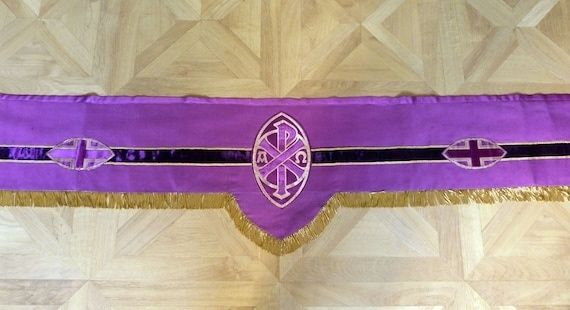
Liturgical color is a practical guide to visual weight. Green is associated with Trinity time, violet with Advent and Lent, white with Christmas, Easter through Pentecost, and other feasts, while red is used at Pentecost and on St. Stephen”s Day. These colors do more than identify a season. They alter the balance of the entire sanctuary. A white cope can gather and scatter light; red can create a concentrated field of intensity; violet can deepen the atmosphere; green can settle the eye into a quieter, continuous rhythm.
- Start with distance. View the vestment as a whole and note its outline, dominant color, and relationship to the architecture.
- Move closer when possible. Look for appliqué edges, changes in stitch direction, overlaps, and areas where the fabric has been deliberately left calm.
- Follow the light. Metallic thread and polished fittings may flare briefly in candlelight, while matte wool or dense silk absorbs illumination.
- Read the surface as labor. Stitch density, tiny irregularities, and layered construction reveal how time and handwork shaped the object.
- Separate observation from interpretation. First describe what is visible, then consider how color, flora, text, and symbolism may function within worship.
The most rewarding details often appear at the boundary between materials. A metallic thread can sharpen the edge of a leaf, while a softer silk thread gives the interior a muted, almost painted tone. Appliqué layering creates small changes in relief, and petitpoint produces a granular surface that becomes legible only at close range. Candlelight is particularly revealing because it does not illuminate evenly. It travels across raised stitches, pauses on gold, and disappears into dark folds. In that shifting light, the vestment becomes less like a flat picture and more like a responsive architectural surface.
Encountering Living Devotion in Modern Needlework
Queen Margrethe II”s church textiles demonstrate how contemporary design can renew inherited ritual without severing its historical roots. In the Haderslev episcopal cope, white silk, orange lining, patchwork, quartz, gold, and the Luther rose form a visual identity for a diocese that once depended on a borrowed historic garment. In the wider body of her work, botanical motifs, hymn texts, and regional references bring worship into contact with the Danish landscape. The meaning is carried not only by symbols, but by texture, weight, movement, and the visible patience of the hand.
That achievement is likely to receive broader public attention through “Thread of Faith: HM Queen Margrethe”s Church Textiles,” an exhibition announced for Koldinghus from 4 June to 28 November 2027. The planned presentation of approximately 30 works should make it possible to compare chasubles, episcopal garments, and embroideries across several decades and locations. Until then, visitors encountering southern Denmark”s cathedrals can practice the same attentive looking: pause before the color, follow the line of a vine, notice where light settles, and allow the fabric to reveal devotion as something made, handled, worn, and continually brought to life.