
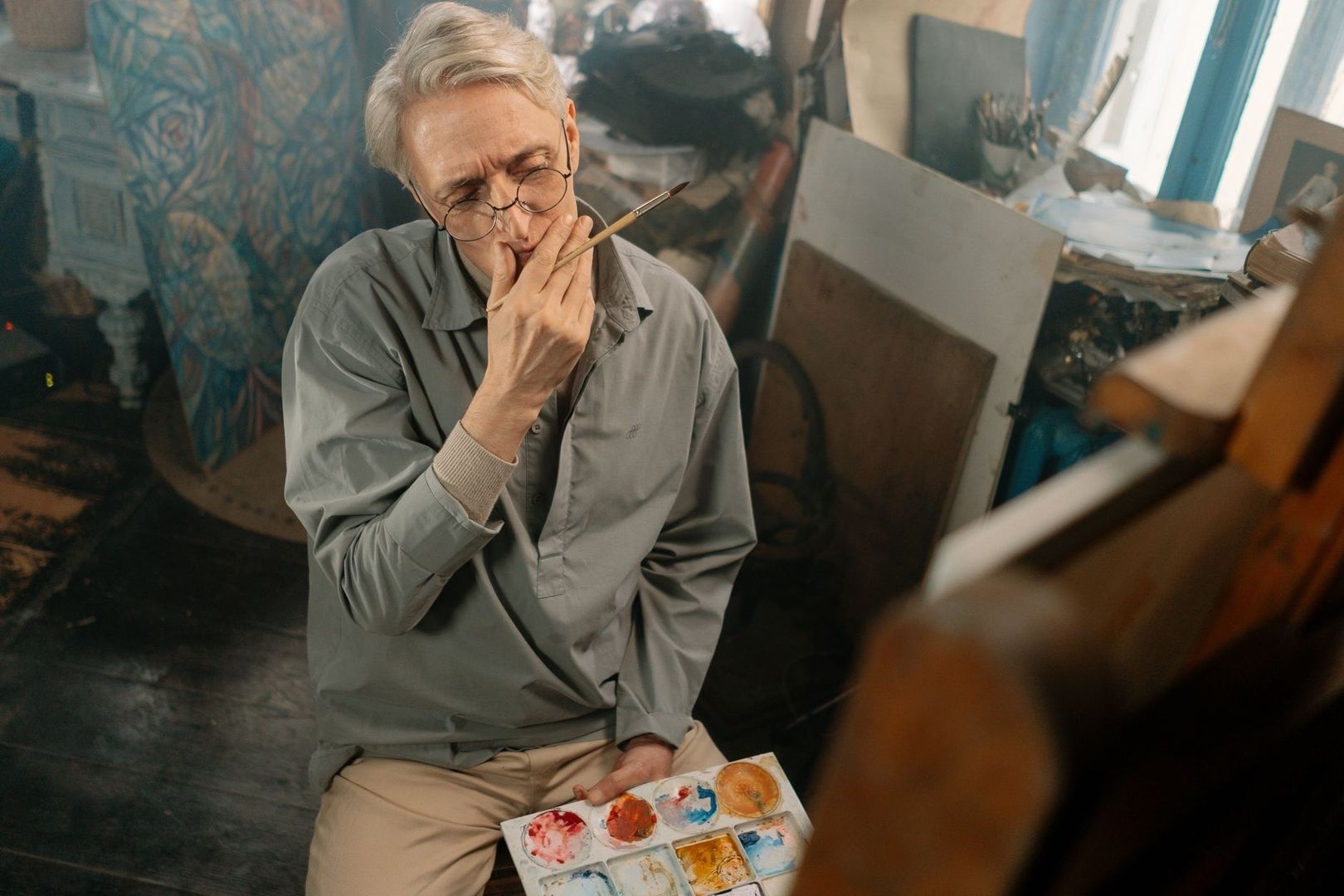
Beyond Surface Mimicry: How to Reverse-Engineer Master Paintings
The Anatomy of Visual Inquiry
A master study becomes transformative at the moment it stops being a polite imitation. Passive copying follows the visible surface, reproducing colors, contours, and small passages as though the painting were a flat image to be transcribed. Active structural deconstruction asks a more consequential question: what sequence of decisions made this image coherent? The painter studies the organization of light, the placement of large shapes, the direction of movement, the hierarchy of edges, and the selective omissions that allow the image to breathe.
Novice painters often become trapped in micro-rendering because detail offers an immediate sense of progress. A carefully described eyelash, fold, or leaf can feel like evidence of diligence, even when the head, figure, or landscape is structurally misplaced. Yet a convincing painting does not begin with isolated facts. It begins with relationships. If the value pattern is weak, the contours uncertain, and the focal area undifferentiated from its surroundings, increasingly refined detail merely polishes an unstable foundation.
Every accomplished painting is a crystallized record of visual problem-solving. Its finished surface conceals decisions about proportion, compression, rhythm, depth, material, and attention. A museum visit can therefore become a form of forensic looking. Rather than asking only what a painting depicts, examine how it organizes perception. This roadmap treats the master copy as a diagnostic instrument, helping self-directed artists inherit a painter”s thought process without borrowing the artist”s identity.
Uncovering Hidden Scaffolding Beneath the Surface
Look closely at a polished painting and the cosmetic finish can seem complete, almost inevitable. Beneath it, however, lies an armature of axes, masses, directional rhythms, and revisions. A hand may have shifted, a shoulder widened, or a head tilted before the final contour settled into place. These changes, known as pentimenti, are not failures concealed by history. They are evidence of active searching, proof that the image was constructed through adjustment rather than delivered fully formed.
Technical examination makes some of this searching visible. Infrared reflectography can reveal underdrawings, repainting, and other information hidden beneath the upper paint layers. Comparative research on infrared reflectography and pulsed thermography shows that the visibility of underdrawing depends not only on the materials involved but also on imaging conditions and signal quality. For the studio artist, the lesson is direct: the apparently effortless surface may rest on a provisional network of lines and shapes that remained flexible while the image developed.
Historical studio practice likewise treated drawing as an architecture of volume. The first marks were not necessarily attempts to perfect an outline. They established proportion, balance, planes, gesture, and the relation of one mass to another. In a contemporary master study, begin by searching for that architecture rather than chasing contour accuracy.
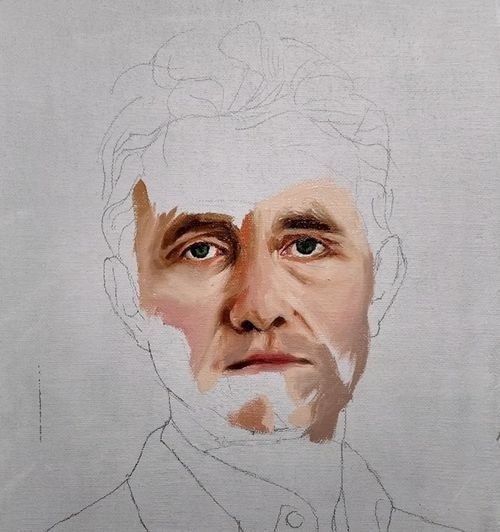
- Identify the dominant vertical, horizontal, and diagonal divisions.
- Reduce the subject to a few interlocking masses before describing its edges.
- Mark the central axis of figures, heads, limbs, or architectural forms.
- Trace repeated rhythms, such as aligned shoulders, branches, folds, or gaze directions.
- Note where the artist allows construction lines to disappear beneath later passages.
This approach turns the copy into a conversation with method. A structured tradition of master study can be explored through historical master study and its broader context on Wikipedia, but the essential practice remains available in any studio: separate the visible result from the decisions that produced it. A limited structural sketch may teach more than a painstaking replica if it exposes why the composition holds together.
Seeing in Values Before Seeing in Details
Before color becomes descriptive, it functions architecturally. A painting”s light and dark shapes establish its weight, depth, atmosphere, and emotional temperature. Tonal massing means grouping related values so that the viewer reads a coherent design rather than a collection of unrelated accents. In a portrait, the shadow side of the head may operate as one broad shape, even though it contains cheek, hair, ear, and neck. In a landscape, distant trees, mountains, and cloud shadows may be compressed into a single family to preserve spaciousness.
Squinting is a simple but powerful diagnostic. When the eyes narrow, small contrasts diminish and the major value families remain. A thumbnail made from this view reveals whether the focal area is genuinely supported by the composition or merely surrounded by busy marks. Value mapping can then clarify the image further by reducing it to three, four, or five tones. The question is not whether every local color has been preserved, but whether the large relationships still carry the subject when detail is removed.
The viewer”s eye moves through a hierarchy, not an equal field of information. Strong contrast, sharper edges, distinctive color, and concentrated detail tend to attract attention. If every passage is equally crisp and dark, the painting loses direction. The following comparison helps distinguish additive rendering from structural massing.
| Additive rendering | Structural massing |
|---|---|
| Builds detail before confirming the major pattern | Establishes large light and shadow groups first |
| Treats every object as equally important | Creates a clear focal hierarchy |
| Preserves local changes even when they fragment the image | Compresses related values to strengthen unity |
| Uses edges with similar sharpness throughout | Varies lost, soft, firm, and accented edges |
| Measures success by visible finish | Measures success by readable structure at a distance |
Stroke economy depends on this foundation. If the large value pattern is correct, a few marks can suggest a surprisingly complex form. If the pattern is wrong, additional brushwork only distributes confusion more elaborately.
The Logic of Stroke Economy and Intentional Marks
Stroke economy is not simply speed, and it is not an excuse for careless execution. It is the ability to make a limited number of marks carry several kinds of information at once: form, light, material, gesture, and atmosphere. John Singer Sargent”s broad passages often describe an entire plane with a single confident movement. Gregory Manchess similarly demonstrates how implied detail can preserve clarity while allowing the surface to remain active. The viewer completes what the brush only suggests.
This economy is easier to understand when compared with photography. A photograph records a dense field of specific information, while a painting can select, suppress, and rearrange. A hand may be indicated by a turn of value and one angular accent rather than a fully modeled inventory of knuckles. Hair can become a directional mass with a few breaks of light. The omission is not a lack of knowledge. At its best, it is evidence that knowledge has been edited.
Many painters resist this editing because precision feels safer. Over-control often disguises anxiety: the fear that a bold mark cannot be corrected, or that a simplified passage will expose insufficient understanding. Yet the goal is not to abandon control. It is to place control earlier, in the decisions about proportion, value, edge, and emphasis, so that the final marks can remain comparatively free. The practical variables described in How to Paint Looser include brush handling, pressure, paint consistency, surface, speed, and the distance at which the brush is held from the ferrule.
- Choose a small subject and describe it with ten deliberate strokes, prioritizing gesture, light direction, and the largest color relationships.
- Repeat the study with a different brush pressure, observing how a loaded mark and a lightly dragged mark alter the sense of form.
- Paint one passage at full speed and another slowly, then compare where energy, softness, or overworking has entered.
- Mix only part of each color on the palette or surface so that the stroke retains variation rather than becoming uniformly flat.
- Reserve the sharpest and most opaque marks for the focal area, allowing peripheral forms to remain implied.
After each exercise, inspect the result from a distance and ask which marks are doing genuine structural work. A stroke should not survive merely because it is attractive. It should remain because it clarifies the image, directs attention, describes a turn, or contributes to the painting”s rhythm.
A Diagnostic Protocol for Studio Study
A productive master study has a sequence. The purpose is not to reproduce the original as efficiently as possible, but to expose its decisions in a controlled order. Work from a reproduction only when direct museum access is impossible, and remember that scale, lighting, surface, and color reproduction can alter what is perceived. In a museum, follow the institution”s copyist rules, credit the original artist, never reproduce the original signature, and identify the exercise as “after” the master. Ethical clarity is part of serious study.
- Begin with a five-minute thumbnail value compression. Use a soft pencil, charcoal, or a broad digital brush. Reduce the painting to three or four value families. Do not draw eyelashes, leaves, buttons, or decorative edges. Test whether the composition remains legible when its descriptive information has been compressed.
- Chart linear vectors and the focal path. Draw the principal axes over a separate tracing layer or beside the reference. Mark the direction of limbs, architectural diagonals, gaze lines, horizon divisions, and major curves. Then indicate how these vectors lead the eye toward, around, or away from the focal area.
- Create a limited-palette massing study. Select a small number of colors, such as a dark neutral, a warm middle, a cool middle, and a light. Establish the largest shapes before mixing subtle transitions. Watch how edge relationships change when two neighboring masses are close in value or strongly separated.
- Perform a selective detail pass. Add only the accents that explain material, focal emphasis, or spatial depth. Compare each proposed mark with the original”s level of emphasis. If a peripheral detail competes with the subject, soften, simplify, or remove it.
- Write a process diagnosis. Record what was difficult, which relationships failed first, and where the original solved a problem with economy. This brief analysis prevents the exercise from becoming a decorative imitation and identifies the next technical study.
Museum copying traditions demonstrate why this order matters. The Metropolitan Museum of Art”s copyist program, founded in 1872, reflects a long history of learning directly from paintings, drawings, and institutional collections. The experience of studying original works also reveals practical realities that reproductions conceal: scale, surface texture, viewing distance, gallery lighting, and the physical authority of the object. Even a short sketch in front of an original can expose a structural decision that disappears on a screen.
Consider making several studies at different scales rather than one exhaustive replica. A small value map tests design, a linear diagram tests construction, and a limited-palette study tests color and edges. Together they form a more complete investigation than a single polished copy. The finished study should remain clearly identified as an educational work after the original, never as an independent claim of authorship.
Carrying Ancient Lessons Into Your Own Visual Voice
The deepest purpose of a master study is not to acquire another painter”s mannerisms. It is to discover how that painter selected, organized, simplified, corrected, and finished visual information. Sargent”s economy, Manchess”s implied detail, or the structural discipline of an atelier can become useful principles without turning into costumes. Inheritance is strongest when it occurs at the level of thought rather than surface style.
Apply the extracted principles to subjects that belong to contemporary life: a crowded train platform, a family kitchen, a weathered storefront, or a figure illuminated by a phone screen. Compress the values, chart the movement, control the focal hierarchy, and let the brush marks serve the structure. A gallery visit can then become less like a search for perfect appearances and more like a dialogue with fellow practitioners across time. Look for the choices beneath the finish, test those choices in your own work, and allow the resulting paintings to speak in a voice that is informed, deliberate, and unmistakably yours.
By Magnus
- 30, Sep, 2026
- 0 Comments